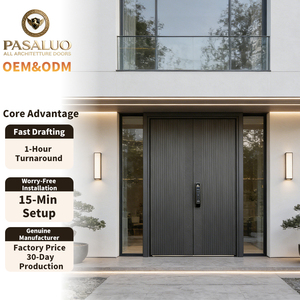
Direct Factory Catalog
Engineered Architectural Window & Door Portfolio
Explore our CE, NFRC, and AS2047 tested aluminum systems manufactured for high-end residential villas, commercial façades, and global distribution.
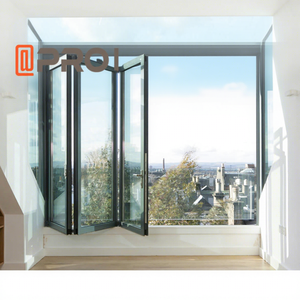
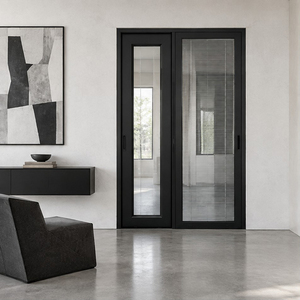
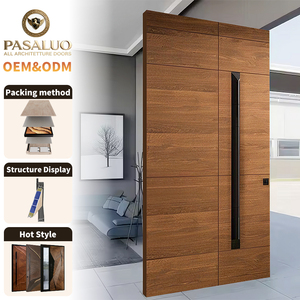
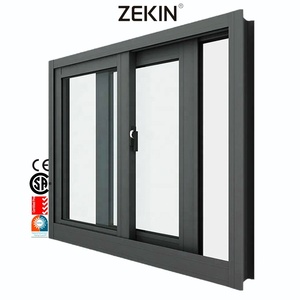
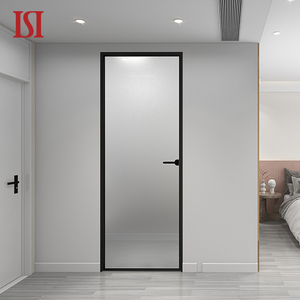
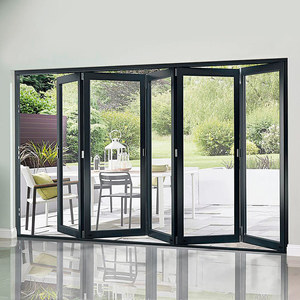
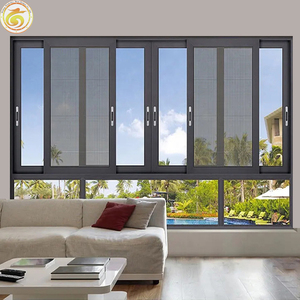
EN 14351-1
CE Compliance Standard
Uw ≤ 1.1
W/m²·K Thermal Value
Class 9A
EN 12208 Watertightness
50,000+
Cycles Operational Testing
1. Executive Summary & European CE Certification (EN 14351-1) Framework
In the contemporary architectural landscape, aluminum folding door systems (commonly designated as bi-fold doors or concertina doors) represent a sophisticated convergence of structural metallurgy, building envelope thermodynamics, and fluid spatial design. As modern residential and commercial developments increasingly favor expansive glass facades, procurement managers, architectural specifiers, and global distributors require transparent, mathematically verifiable engineering performance metrics. Sourcing CE-certified aluminum folding doors from verified Chinese manufacturers provides a distinct competitive edge, reconciling high-end aesthetic customization with rigorous European standard compliance.
The CE marking under standard EN 14351-1 (Windows and doors - Product standard, performance characteristics) is mandatory for any architectural fenestration product imported into or specified within the European Economic Area (EEA). Compliance confirms that the bi-fold door assembly satisfies stringent health, safety, and environmental protection benchmarks. A legitimate CE Declaration of Performance (DoP) from an established wholesaler guarantees that the profile structure, hardware sub-assemblies, EPDM gaskets, and Insulated Glass Units (IGUs) have undergone rigorous third-party initial type testing (ITT).
Key Engineering Takeaway: Non-compliant bi-fold doors under structural wind load experience frame deflection, panel sagging, and seal degradation—causing air infiltration and thermal bridging. CE EN 14351-1 testing verifies resistance to wind loads up to Class C5 (EN 12210) and water tightness up to Class 9A (EN 12208, 600 Pa test pressure).
Essential Performance Characteristics Verified Under EN 14351-1
When reviewing wholesale technical submittals, global procurement officers must mandate verification across five core technical vectors:
- Thermal Transmittance ($U_w$ Value): Calculated via ISO 10077-1 and ISO 10077-2, incorporating frame transmittance ($U_f$), glass transmittance ($U_g$), and linear thermal bridging of glass edge spacers ($\Psi_g$). Modern polyamide thermal break profiles achieve overall system $U_w$ ratings down to $1.1 - 1.4 \text{ W/m}^2\text{K}$.
- Air Permeability (EN 12207): Classified from Class 1 to Class 4. High-performance bi-fold folding doors utilize multi-layer continuous EPDM gaskets to maintain Class 4 integrity (air leakage ≤ $3 \text{ m}^3/\text{h}\cdot\text{m}^2$ at 600 Pa).
- Watertightness (EN 12208): Evaluated via pulsating water spraying up to extreme pressure thresholds. Premium bottom track drainage channels with concealed weep holes achieve Class 9A or E1050 ratings.
- Resistance to Wind Load (EN 12210): Measures structural safety and relative frontal deflection ($p3 \text{ pressure} \le 1/300 \text{ frame length}$). Structural multi-point locking pins ensure stability under dynamic loads up to 2400 Pascals.
- Operating Forces & Mechanical Durability (EN 12046-2 / EN 12400): Verifies that smooth operation is maintained over 50,000 continuous opening/folding cycles under maximum leaf weight conditions (up to 150 kg per sash).
2. Technical Specification Matrix: Heavy-Duty vs. Slim-Line Folding Doors
Choosing the correct profile depth, alloy temper, and hardware carriage mechanism is essential for structural longevity. The technical matrix below compares standard commercial-grade bi-folds with ultra-slim architectural folding door systems provided by leading Foshan manufacturing facilities.
| Parameter | Heavy-Duty Thermal Break Bi-Fold (75 Series) | Ultra-Slim Architectural Bi-Fold (68 Series) | Standard Non-Thermal Folding Door |
|---|---|---|---|
| Aluminum Alloy & Temper | Primary 6063-T6 High-Precision Extrusion | Primary 6063-T6 Structural Grade | Secondary 6063-T5 Extrusion |
| Profile Wall Thickness | 2.0mm – 3.0mm Structural Reinforcement | 1.8mm – 2.2mm Precision Profile | 1.2mm – 1.4mm Commercial Grade |
| Thermal Barrier Technology | 24mm – 34mm PA66-GF25 Polyamide Strips | 18.8mm PA66 Polyamide Thermal Break | None (Monolithic Aluminum) |
| Glass Configuration | 5mm + 18Ar + 5mm Low-E Double/Triple IGUs | 6mm + 12Ar + 6mm Tempered Glazing | 5mm + 9A + 5mm Clear Double Glass |
| Roller Carriage Hardware | Top-Hung Heavy-Duty Stainless Steel 304 Quad-Rollers | Bottom-Rolling Precision Ball Bearing Track | Zinc Alloy Surface-Mounted Rollers |
| Acoustic Rating (STC / Rw) | 38 dB – 44 dB Sound Attenuation | 32 dB – 36 dB Sound Reduction | 22 dB – 26 dB Standard Rating |
| CE Standard Compliance | Full EN 14351-1, EN 12208 Class E1050 | Full EN 14351-1, EN 12207 Class 4 | Basic Mechanical Compliance |
3. Global Sourcing Trends & Innovations in Aluminum Folding Systems (2026–2030)
The global architectural fenestration sector is experiencing a rapid technological paradigm shift driven by stringent building energy codes (such as Europe's Energy Performance of Buildings Directive - EPBD), decarbonization commitments, and smart automation requirements. Wholesalers and developers must anticipate these macro-market shifts when formulating multi-year procurement contracts with primary manufacturers.
A. Recycled Low-Carbon Aluminum Billets & Environmental Product Declarations (EPD)
With carbon border adjustment mechanisms (CBAM) coming into force across major European and North American trade zones, primary aluminum profile production must shift toward low-carbon processing. Leading wholesale suppliers in Foshan are adopting hydro-powered aluminum smelting and post-consumer recycled aluminum alloys (achieving emissions below $4.0 \text{ kg CO}_2\text{e/kg Al}$). Importers can now request comprehensive Environmental Product Declarations (EPDs) alongside standard CE DoP documentation to secure green building certifications such as LEED v4 and BREEAM.
B. Integration of Electrochromic Glass & Automated Actuators
Future-proof bi-fold doors are expanding beyond passive building envelope elements into dynamic smart facades. Premium product lines now offer integrated electrochromic switchable glass—allowing end users to alter glazing tint and solar heat gain coefficient (SHGC) via IoT home automation protocols or mobile interfaces. Furthermore, heavy-duty top-hung folding mechanisms are increasingly fitted with concealed motorized drive belts and anti-pinch safety sensors, facilitating automated barrier-free access for luxury hospitality and accessibility-focused residential projects.
C. Extreme Weather & Hurricane Impact Engineering
Climate volatility has accelerated global demand for high-performance hurricane-impact bi-fold systems. Modern coastal developments demand folding glass doors capable of passing missile impact tests (TAS 201/202/203 or ASTM E1886/E1996) alongside AS2047 cyclic pressure protocols. High-performance suppliers integrate laminated impact glass (featuring Saflex or SentryGlas interlayers) paired with internal steel structural stiffeners embedded directly within the primary aluminum extrusion chambers.
4. Enterprise Manufacturing Strengths & Supply Chain Dominance
Operating out of Foshan, Guangdong—the world’s premier aluminum manufacturing cluster—our factory infrastructure spans decades of specialized engineering, supporting global brands, contractors, and trading conglomerates with custom OEM/ODM solutions.
100,000+ Completed Projects
Proven engineering deployment across North America, Europe, Australia, and the Middle East, satisfying complex architectural opening schedules.
Multi-Standard Certification
Products tested to EN 14351-1 (CE), NFRC thermal metrics, AS2047 Australian window standards, under an ISO 9001 quality system.
OEM / ODM & Wholesale Pricing
Direct factory volume pricing, customized extrusion profiles, private label packaging, hardware selection, and dedicated account management.
Our quality control workflow includes rigorous structural testing at every stage of production: raw aluminum chemical composition spectroscopy, powder coating thickness verification (Qualicoat Class 2 standards), automated dual-component corner crimping with epoxy injection, and complete pre-shipment dry-fit assembly testing.
5. Frequently Asked Questions (FAQ) for B2B Importers & Specifiers
Detailed technical answers addressing common procurement, compliance, and engineering inquiries regarding CE-certified aluminum folding door imports.
How do I verify the authenticity of a factory’s CE Certificate under EN 14351-1?
Authentic CE compliance requires an official Declaration of Performance (DoP) supported by Initial Type Testing (ITT) test reports issued by an accredited European Notified Body (NB). Check the certificate's NB identification number against the EU NANDO database. The report must explicitly list the door series, thermal break dimensions, glass make-up, and exact profile wall thickness tested.
What is the structural advantage of top-hung versus bottom-rolling bi-fold door hardware?
Top-hung bi-fold systems carry the primary door panel weight on a reinforced head track via heavy-duty stainless steel quad-rollers. This prevents debris accumulation from binding the mechanism, resulting in smoother long-term operation. However, top-hung designs require a load-bearing structural lintel. Bottom-rolling systems transfer weight to the floor substrate, ideal for retrofit installations where overhead structural capacity is limited.
How does polyamide (PA66-GF25) thermal break technology improve system U-values?
Aluminum is highly conductive ($K \approx 200 \text{ W/m}\cdot\text{K}$). A polyamide thermal break consists of precision-engineered glass-fiber reinforced nylon strips ($K \approx 0.3 \text{ W/m}\cdot\text{K}$) mechanically crimped between the interior and exterior aluminum profiles. This structural barrier interrupts conductive heat flow, eliminating internal frame condensation and significantly lowering the frame thermal transmittance ($U_f$).
What container packaging protection is provided for bulk export shipments?
Export shipments are packed using a four-tier protection protocol: 1) Protective PE film on all profile surfaces; 2) Corner guard shock absorption; 3) Multi-layer bubble wrap around individual sashes; 4) Fumigated fully enclosed plywood crates with internal structural banding. Packed crates include exterior weight, volume, and balance labels for safe forklift handling.
Can folding doors be customized for extreme wind load or hurricane coastal zones?
Yes. High-wind and coastal configurations utilize 6063-T6 aluminum profiles with structural wall thicknesses up to 3.0mm, internal structural steel core stiffeners, laminated impact-resistant glass (SGP interlayer), heavy-duty multi-point locking pins, and corrosion-resistant powder coatings compliant with AAMA 2605 or Qualicoat Seaside standards.
Partner with a Certified Aluminum Door Wholesaler
Request full CE technical submittals, custom shop drawings, factory-direct OEM pricing, and complete architectural catalogs for your upcoming project or distribution network.