Technical Engineering & Material Science of OEM Custom Aluminium Framed Glass Doors
Information Gain Insight: Modern high-rise and luxury residential fenestration demands structural integrity beyond standard decorative extrusions. Custom OEM aluminium framed glass door engineering requires a precise synthesis of alloy selection, thermal break geometry, glass matrix acoustics, and dynamic wind-load resistance.
As a premier factory-direct manufacturer and global wholesale supplier headquartered in Foshan, Guangdong—China's industrial capital for precision aluminum extrusions—Kora Aluminum Windows & Doors Co., Ltd. redefines architectural fenestration through engineered precision. Commercial buyers, project developers, and building material distributors require verifiable technical parameters rather than generic claims. Below is an exhaustive breakdown of the technical specifications that distinguish commercial-grade OEM aluminium framed glass door manufacturing.
1. Metallurgy & Structural Extrusion Profiles (6063-T5 vs. 6063-T6)
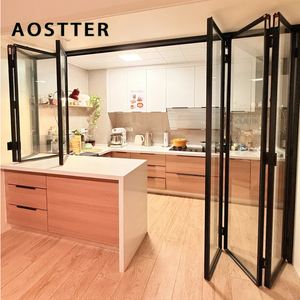
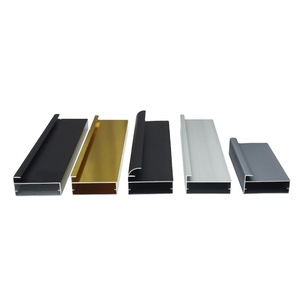
The structural backbone of any high-span folding, sliding, or pivot door is the aluminum extrusion alloy. Standard commercial doors frequently employ low-grade or recycled aluminum billets that suffer from interior structural voiding and inconsistent wall thickness. Kora strictly specifies primary 6063-T5 and high-tensile 6063-T6 architectural aluminum alloy extrusions with a nominal wall thickness ranging from 2.0mm to 3.0mm depending on the structural load requirements of the opening.
- Tensile Yield Strength: 6063-T6 profiles achieve a ultimate tensile strength of $\ge 205 \text{ MPa}$ and yield strength of $\ge 170 \text{ MPa}$, allowing for ultra-slim sightlines without compromising structural deflection standards under severe gust pressure ($P_3 \ge 4000 \text{ Pa}$).
- Polyamide Thermal Break Integration (PA66-GF25): To eliminate thermal bridging, our thermally broken series utilize imported German-engineered PA66-GF25 (Polyamide 66 reinforced with 25% glass fiber) thermal barrier strips. This maintains identical thermal expansion coefficients with the aluminum housing, preventing seal degradation over 30+ year service life cycles.
2. Advanced Thermal & Solar Control Glazing Configurations
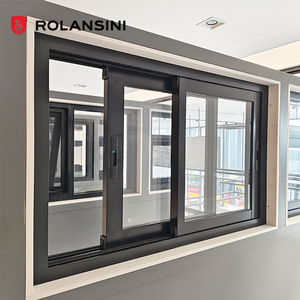
Glass constitutes over 80% of an aluminium framed door's surface area. Achieving low overall assembly U-factors ($U_w$) requires engineered insulated glass units (IGU) equipped with warm-edge spacers, low-emissivity (Low-E) soft coatings, and inert gas fillings.
| Glazing Makeup | Overall Thickness | U-Factor ($W/m^2 \cdot K$) | SHGC Range | Acoustic Rating (STC) | Primary Target Application |
|---|---|---|---|---|---|
| Double Low-E + Argon 6mm Low-E + 12Ar + 6mm Clear |
24 mm | 1.6 – 1.8 | 0.32 – 0.40 | 35 – 38 dB | Standard Residential & Mild Climates |
| Triple Insulated Low-E 5mm Low-E + 9Ar + 5mm + 9Ar + 5mm |
33 mm | 1.1 – 1.3 | 0.25 – 0.32 | 38 – 42 dB | Passive House & Severe Cold Zones |
| Hurricane Impact Laminated 6mm Temp + 1.52 SGP + 6mm Temp + 12Ar + 6mm |
31.52 mm | 1.4 – 1.6 | 0.28 – 0.35 | 42 – 46 dB | Coastal High-Wind & Hurricane Belts |
| Acoustic PVB Laminated 5mm + 0.76 Acoustic PVB + 5mm + 14Ar + 6mm |
30.76 mm | 1.5 – 1.7 | 0.35 – 0.42 | 45 – 50 dB | Urban Commercial & Airport Flight Paths |
3. Surface Treatment Engineering: PVDF Coating vs. Anodizing vs. Powder Coating
To resist salt-spray atmospheric corrosion (C5-M environment rating) in coastal installations, the surface finishing process must adhere to stringent thickness and adhesion criteria:
- Fluorocarbon PVDF Spraying (70% Kynar 500): Applied in a 3-coat/2-bake automated line yielding a dry film thickness of $\ge 40 \mu m$. Exceeds AAMA 2605 requirements with zero chalking or color fading over 20 years under intense UV radiation.
- Qualicoat Class 2 Architectural Powder Coating: Offers high scratch resistance and wide RAL color matching. Cured at precise temperatures to guarantee film adhesion against chemical abrasion.
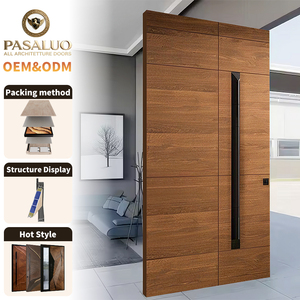
- Hard Anodizing (Class 1 - 25 Micron): Converts the aluminum surface layer into an ultra-hard aluminum oxide layer, delivering superior metallic metallic depth and scratch protection for high-traffic entry pivot doors.