Industrial Whitepaper: Engineering & Sourcing Architecture for Commercial Aluminum Glass Doors
As modern architectural trends push toward expansive clear spans, ultra-slim sightlines, and aggressive building envelope performance targets, the global demand for architectural-grade custom OEM aluminum glass doors has entered a highly technical era. For B2B importers, commercial developers, and building material wholesalers, selecting an OEM exporter is no longer purely a cost-per-square-meter exercise. It requires a rigorous technical evaluation of metallurgical alloy grades, thermal break barrier physics, acoustic insulation STC thresholds, and long-term surface treatment durability against extreme weathering.
Direct Sourcing Director's Takeaway
Sourcing aluminum fenestration products from China requires verifying that the supplier uses primary 6063-T5 or T6 aluminum billets rather than remelted scrap aluminum. Billet purity dictates structural yield strength ($f_y \ge 170\text{ MPa}$), color uniformity during anodizing, and long-term resistance to structural fatigue under high wind-load deflections.
1. Advanced Thermal Break Metallurgy & Polyamide PA66GF25 Engineering
Uninsulated aluminum exhibits high thermal conductivity ($\lambda \approx 200\text{ W/m}\cdot\text{K}$), making raw aluminum frames significant thermal bridges in climate-controlled structure envelopes. To comply with modern energy codes such as ASHRAE 90.1, IECC, and Australia's NCC Section J, high-performance aluminum doors must incorporate structural thermal breaks.
In our factory manufacturing process, we utilize extruded Polyamide 66 reinforced with 25% glass fiber (PA66GF25) thermal barrier strips inserted between the interior and exterior aluminum profile extrusions. The key technical advantages of PA66GF25 include:
- Coefficient of Thermal Expansion (CTE) Matching: The CTE of PA66GF25 ($2.5 \times 10^{-5}/\text{K}$) closely mirrors that of structural aluminum ($2.3 \times 10^{-5}/\text{K}$). This prevents interface shear failure, delamination, and seal degradation across ambient operating ranges from $-30^\circ\text{C}$ to $+80^\circ\text{C}$.
- Low Thermal Conductivity: PA66GF25 features a thermal conductivity of only $\approx 0.30\text{ W/m}\cdot\text{K}$, reducing total frame U-factors ($U_f$) down to $1.2 - 1.8\text{ W/m}^2\cdot\text{K}$ when combined with multi-cavity insulation foam inserts.
- Structural Shearing Resistance: Transverse shear strength exceeding $70\text{ N/mm}$ ensures that heavy double- or triple-glazed door sashes remain structurally rigid under severe wind pressures.
2. Glazing Configurations: Low-E Coating Physics & Acoustic Soundproofing (STC/Rw)
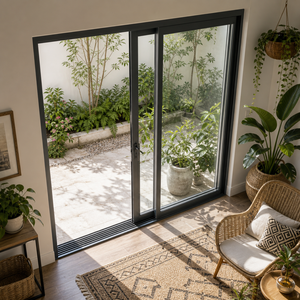
The glass unit accounts for 75% to 90% of the overall surface area of a patio sliding or casement door. Achieving optimal thermal and acoustic insulation requires tailored Insulated Glass Unit (IGU) make-ups:
| Glazing Assembly Configuration | Overall Thickness | Center-of-Glass U-Value (W/m²K) | SHGC Range | Acoustic Rating (STC) | Primary Commercial Use Case |
|---|---|---|---|---|---|
| Double Tempered Clear (6mm + 12A + 6mm) | 24 mm | 2.7 - 2.8 | 0.68 - 0.75 | STC 31 - 33 | Standard Interior / Mild Climate Exterior |
| Double Low-E + Argon Gas (6mm + 16Ar + 6mm) | 28 mm | 1.3 - 1.5 | 0.25 - 0.40 | STC 34 - 36 | Energy-Efficient Residential & Commercial |
| Acoustic PVB Laminated (5mm + 0.76PVB + 5mm + 12Ar + 6mm) | 28.76 mm | 1.4 - 1.6 | 0.30 - 0.45 | STC 39 - 42 | Urban Multi-Family, Airport & Hotel Zones |
| Triple-Pane Low-E Warm Edge (5mm + 12Ar + 5mm + 12Ar + 5mm) | 39 mm | 0.8 - 1.0 | 0.20 - 0.32 | STC 38 - 41 | Passive House / Extreme Cold Climates |
For high-noise urban environments, sound dampening is achieved by breaking acoustic wave symmetry. Combining dissimilar glass thicknesses (e.g., 6mm exterior tempered + 8mm interior acoustic laminated) disrupts resonant frequencies, significantly lowering noise penetration across human-audible spectrums ($125\text{Hz} - 4000\text{Hz}$).
3. Future Trends in B2B Aluminum Door Procurement (2025–2030)
The global wholesale market for architectural aluminum doors is undergoing major shifts driven by policy, aesthetics, and hardware technology. Importers and wholesalers must align their purchasing strategies with four dominant macro trends:
A. Ultra-Slim Interlock Sightlines with High Structural Wind Resistance:
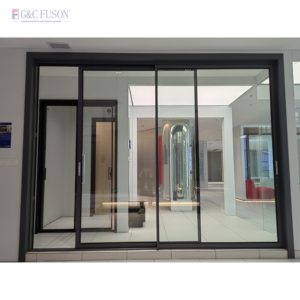
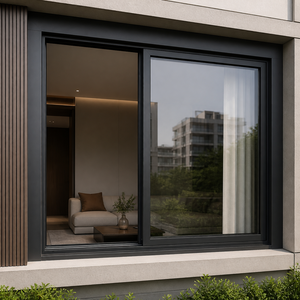
Architects and luxury homeowners increasingly specify "invisible frame" doors. Products like our RG40 Minimalist Sliding Series feature interlock sightlines as narrow as 16mm to 21mm. Achieving structural stability with such slim profiles requires embedding high-moment-of-inertia steel or carbon-fiber stiffeners inside the aluminum interlock cavity, maintaining wind load resistance up to 3000 Pa (equivalent to Category 4 cyclone conditions).
B. Circular Economy Aluminum & Low-Carbon Extrusions:
European and North American project specifications increasingly mandate Environmental Product Declarations (EPDs). Primary aluminum produced via hydro-powered smelting generates significantly lower carbon emissions ($\approx 4\text{ kg CO}_2/\text{kg Al}$) compared to coal-powered smelting ($\approx 16\text{ kg CO}_2/\text{kg Al}$). OEM suppliers who utilize certified low-carbon billet stock provide a distinct competitive bidding advantage in green building tenders (LEED, BREEAM).
C. Motorized Smart Automation & Concealed Hardware Integration:
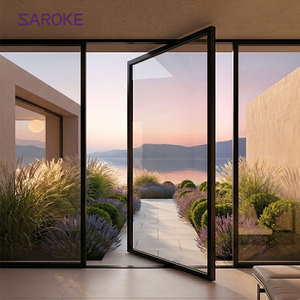
Large-span lift-and-slide and pivot doors are transitioning toward integrated motorization. Concealed brushless DC motors housed within the top frame head allow smartphone, home automation, or biometric access control while keeping operating force under $15\text{ N}$, complying with ADA accessibility guidelines.
D. Fluorocarbon Coating Durability (PVDF vs. Standard Powder Coating):
For coastal real estate and high-UV tropical regions, standard polyester powder coating often chalks and fades within 3 to 5 years. Direct buyers are upgrading to 2-coat or 3-coat Fluorocarbon PVDF coatings (Kynar 500) tested to AAMA 2605 specifications. PVDF coatings resist salt spray corrosion for over 3,000 hours and hold color integrity under severe sunlight exposure for more than 20 years.